
Why Companies Are Abandoning Legacy ERPs in 2026
Discover why mid-market businesses are ditching the hidden modular fees of legacy ERPs like NetSuite and SAP for flat-rate solutions like Odoo.
ERPODOO ERP & SUPPLY CHAINDIGITAL TRANSFORMATION
Chintan | ERP & Fintech Consultant
3/13/20262 min read
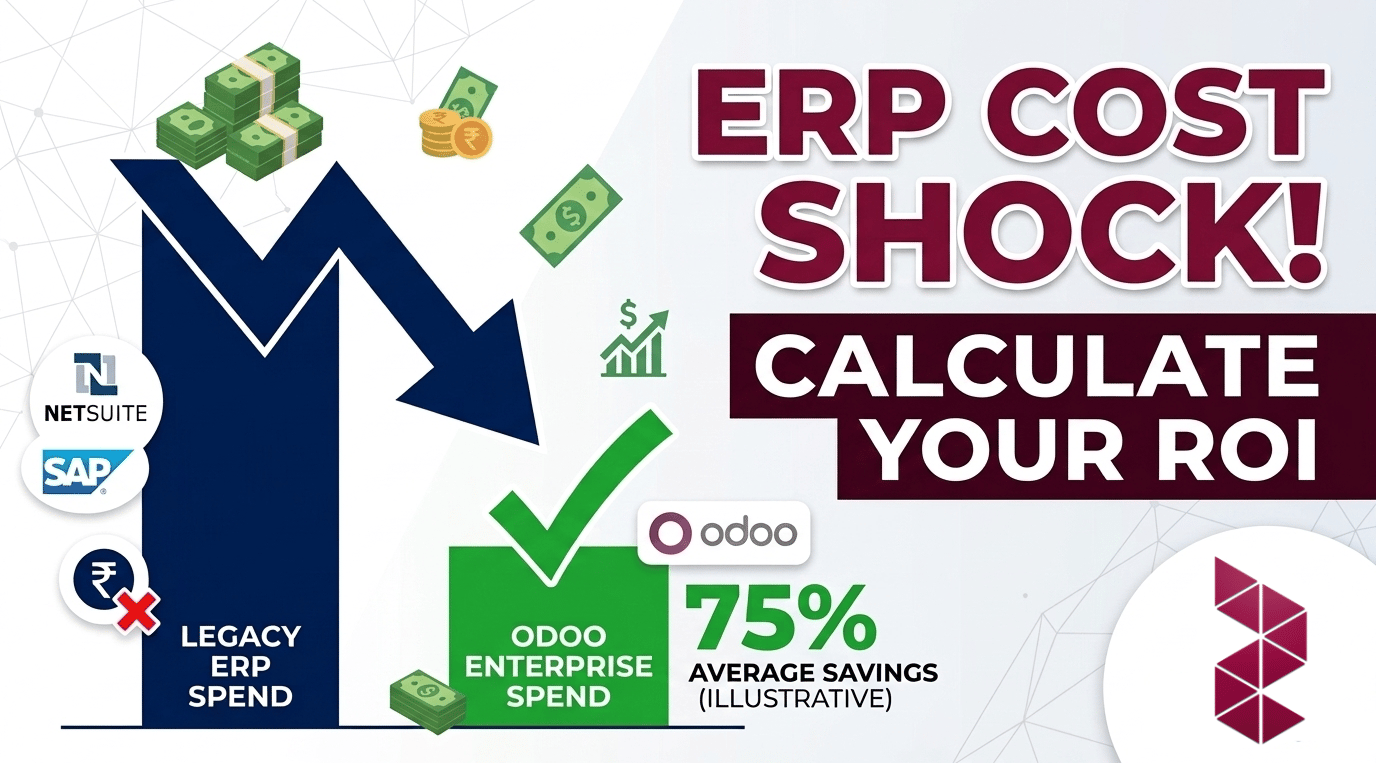
There is a dangerous financial trap hiding in the enterprise software market, and scaling businesses are falling right into it.
You outgrow your basic accounting software (like Tally or QuickBooks) and realize you need a real Enterprise Resource Planning (ERP) system to handle your inventory, sales, and manufacturing. You evaluate the legacy giants—Oracle NetSuite, SAP Business One, Microsoft Dynamics—and sign a contract based on a seemingly reasonable base user license.
Then, your business actually starts to grow. And that is when the trap snaps shut.
The "SaaS Hostage" Situation Legacy ERP systems were built on a pricing model designed for the 2010s: The Modular Paywall.
They don't sell you a complete system; they sell you fragments. The moment you need your ERP to do what an ERP is supposed to do—unify your entire business—you get penalized.
Want to run advanced manufacturing (MRP)? That’s an extra $3,000 a year.
Need to add a CRM to track your sales pipeline? Add another $1,500.
Want to connect your Shopify store or track POS data? Upgrade to the premium integration tier.
By year two of implementation, CFOs are staring at a software bill that has ballooned by 300%. You are held hostage by your own operational growth.
The User-License Penalty The second hidden cost draining IT budgets in 2026 is the rigid user-license model.
Imagine hiring a new warehouse worker. Their only job in the system is to scan barcodes for 15 minutes a day. Legacy vendors often force you to buy them a "Full" or "Limited" access license, artificially inflating your monthly burn rate by $100+ per month for a user who barely touches the software.
The Open-Source Disruption: Why Odoo is Winning The market has reached a breaking point, and it has triggered a massive migration toward modern, open-source architecture—specifically Odoo Enterprise.
Odoo completely disrupted the legacy software market by doing the unthinkable: They killed the module paywall. Because of its modern framework, Odoo moved to a flat, per-user pricing structure. If you pay the single user fee, your business gets unrestricted access to all 80+ enterprise applications.
Accounting
Advanced Manufacturing (MRP)
Omnichannel POS
CRM & WhatsApp Integration
E-commerce & Website Builder
All of it is included out-of-the-box. If you launch a new department next month, your IT team simply turns the app on. No paywalls. No contract renegotiations. No surprise invoices.
Calculate Your True TCO Before You Sign The enterprise software industry desperately needs pricing transparency. Business leaders shouldn't have to guess what their software will cost in Year 2 or Year 3 of a deployment.
At Rising Technologies, we got tired of watching mid-market companies get burned by hidden fees. So, we built an interactive, ungated ERP Savings Calculator.
Instead of hiding the math, our tool lets you input your total user count and the specific modules you need. It instantly calculates the 3-year Total Cost of Ownership (TCO) of a legacy modular ERP versus a modern flat-rate ERP like Odoo.
Before you sign a vendor renewal or implementation contract, run your numbers. You might be shocked at what your current system is actually costing you.
👉 Access the Free License & Module ROI Calculator Here
(Stuck in a NetSuite or SAP contract? Explore our secure ERP migration services to see how we transition your historical data with zero downtime).